Notes and a simple summary of Chapter 8 of the NCERT Class 10 Mathematics book, with the official chapter PDF, flashcards, an MCQ quiz and an AI tutor for your doubts.
🎧 Listen to the content
Summary: Introduction to Trigonometry
Introduction
Trigonometry means the measurement of the sides and angles of a triangle. It began with astronomers who needed to find distances they could not measure directly — like the distance from the Earth to the Moon. In this chapter we work only with acute angles in a right-angled triangle and learn six ratios, their values for special angles, and three identities that connect them.
Key Concepts & Theorems
1. The six trigonometric ratios
Name the sides from the angle you are looking at: opposite, adjacent, hypotenuse.
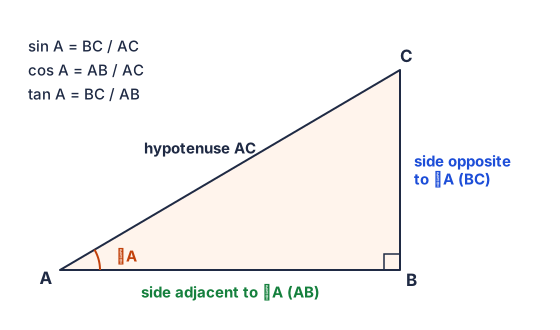
In right-angled triangle ABC, right-angled at B, consider the acute angle A. The side opposite A is BC, the side adjacent to A is AB, and AC is the hypotenuse.
sin A = side opposite to ∠A / hypotenuse = BC/AC
cos A = side adjacent to ∠A / hypotenuse = AB/AC
tan A = side opposite / side adjacent = BC/AB
cosec A = 1/sin A = AC/BC
sec A = 1/cos A = AC/AB
cot A = 1/tan A = AB/BC
Also, tan A = sin A / cos A and cot A = cos A / sin A.
Important facts from the book:
"sin A" is one symbol — it is not sin × A.
The value of a ratio depends only on the angle, not on the size of the triangle (similar triangles give the same ratio).
Since the hypotenuse is the longest side, sin A and cos A are always less than 1 for an acute angle; sec A and cosec A are always ≥ 1.
2. Ratios of specific angles (0°, 30°, 45°, 60°, 90°)
The book derives these using an isosceles right triangle (for 45°) and an equilateral triangle of side 2a cut in half (for 30° and 60°).
sin: 0°→0, 30°→1/2, 45°→1/√2, 60°→√3/2, 90°→1
cos: 0°→1, 30°→√3/2, 45°→1/√2, 60°→1/2, 90°→0
tan: 0°→0, 30°→1/√3, 45°→1, 60°→√3, 90°→not defined
Memory tip: write 0, 1, 2, 3, 4 → divide by 4 → take square roots: √(0/4), √(1/4), √(2/4), √(3/4), √(4/4) gives sin 0°, 30°, 45°, 60°, 90°. Reverse the order for cos.
As A increases from 0° to 90°, sin A increases from 0 to 1 and cos A decreases from 1 to 0.
3. Trigonometric identities
An equation that is true for all values of the angle is an identity. Dividing AB² + BC² = AC² by AC², AB² and BC² gives:
sin²A + cos²A = 1 (for 0° ≤ A ≤ 90°)
1 + tan²A = sec²A (for 0° ≤ A < 90°)
1 + cot²A = cosec²A (for 0° < A ≤ 90°)
Using these, any one ratio can be written in terms of any other (Example 9: cos A = √(1 – sin²A), tan A = sin A/√(1 – sin²A), sec A = 1/√(1 – sin²A)).
Methods Step by Step
Finding all ratios when one is given:
Draw a right triangle and mark the angle.
Use the given ratio to label two sides as k and mk (any positive k).
Find the third side with Pythagoras.
Write the remaining ratios.
Proving an identity: start from the more complicated side, convert everything to sin and cos, use sin²A + cos²A = 1, and simplify to the other side.
Worked Examples
Given tan A = 4/3, find the other ratios. Take BC = 4k, AB = 3k. Then AC = 5k. So sin A = 4/5, cos A = 3/5, cosec A = 5/4, sec A = 5/3, cot A = 3/4.
In △OPQ right-angled at P, OP = 7 cm and OQ – PQ = 1 cm. Find sin Q, cos Q. OQ² – PQ² = 49 ⇒ (OQ – PQ)(OQ + PQ) = 49 ⇒ OQ + PQ = 49. So OQ = 25, PQ = 24. sin Q = 7/25, cos Q = 24/25.
In △ABC right-angled at B, AB = 5 cm, ∠ACB = 30°. Find BC and AC. tan 30° = AB/BC ⇒ 1/√3 = 5/BC ⇒ BC = 5√3 cm; sin 30° = AB/AC ⇒ 1/2 = 5/AC ⇒ AC = 10 cm.
In △PQR right-angled at Q, PQ = 3 cm, PR = 6 cm. Find ∠QPR and ∠PRQ. sin R = PQ/PR = 3/6 = 1/2 ⇒ ∠PRQ = 30°, so ∠QPR = 60°.
If sin(A – B) = 1/2 and cos(A + B) = 1/2, find A and B. A – B = 30°, A + B = 60° ⇒ A = 45°, B = 15°.
Prove sec A (1 – sin A)(sec A + tan A) = 1. LHS = (1/cos A)(1 – sin A)(1 + sin A)/cos A = (1 – sin²A)/cos²A = cos²A/cos²A = 1 = RHS.
👩🏫 Class 10 Mathematics classes near you — online or at home
Prefer a real teacher? TalentJR teachers take live online classes anywhere in India and visit homes in selected cities. Tell us what you need and our team will call you with timings and fees.
💻Live online classesSmall groups or 1:1 with a teacher, from home, any city.
🏠Teacher at homeA TalentJR teacher visits your home (selected cities).
🏫At a centreClasses at a TalentJR partner centre near you, where available.