Explain it in most simpliest way
Please let me know what specific topic or concept from the chapter "Heredity" you would like me to explain in a simple way.

NCERT book: Science - Class 10
Notes and a simple summary of Chapter 8 of the NCERT Class 10 Science book, with the official chapter PDF, flashcards, an MCQ quiz and an AI tutor for your doubts.
🎧 Listen to the content
Reproduction produces offspring that are similar to their parents, but subtly different. In a sugarcane field there is very little variation among plants, but in animals that reproduce sexually — including humans — variations are clearly visible. This chapter explains how variations are created and how traits are inherited from one generation to the next.
Each generation inherits a common basic body design from the previous one plus subtle changes; the next generation then adds its own changes. Asexual reproduction (for example, one bacterium dividing) produces only very minor differences due to small inaccuracies in DNA copying, while sexual reproduction generates much greater diversity. Not all variations have equal chances of survival — bacteria that can withstand heat survive better in a heat wave. Selection of variants by the environment forms the basis of evolution.
A child has all the basic features of a human being but does not look exactly like its parents. Both parents contribute practically equal amounts of genetic material, so for each trait there are two versions in each child. Activity 8.1 looks at free and attached earlobes — two variants in human populations — and asks students to find a rule for their inheritance.
Gregor Johann Mendel (1822–1884) was educated in a monastery and studied science and mathematics at the University of Vienna. He grew garden peas and was the first to keep count of individuals showing a particular trait in each generation. He used contrasting characters such as round/wrinkled seeds, tall/short plants and white/violet flowers.
Monohybrid cross (one trait):
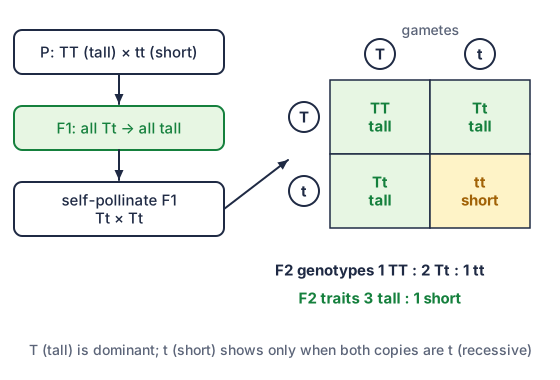
TT × tt → F1: Tt (all tall) → F1 selfed → F2: TT : Tt : tt = 1 : 2 : 1 (genotype), tall : short = 3 : 1 (phenotype)
Traits like T that show up with a single copy are dominant; traits like t that need both copies to show are recessive.
Dihybrid cross (two traits): The book's Fig. 8.5 crosses a plant with round green seeds (RRyy) with one with wrinkled yellow seeds (rrYY). All F1 plants are round and yellow (RrYy), so round and yellow are dominant. In F2, new combinations appear — round-green and wrinkled-yellow — in the ratio 9 : 3 : 3 : 1. The figure's actual counts are 315 round yellow, 108 round green, 101 wrinkled yellow and 32 wrinkled green, a total of 556 seeds. This shows that the two traits are inherited independently. (The book's text uses the same idea for tall/round and short/wrinkled plants.)
Cellular DNA is the information source for making proteins. A section of DNA that provides information for one protein is a gene. Example: plant height depends on the amount of a growth hormone, which depends on the efficiency of an enzyme. If the gene for that enzyme is altered so that the enzyme works less efficiently, less hormone is made and the plant is short. Genes control characteristics.
Each gene set is present as separate pieces called chromosomes. Every cell has two copies of each chromosome — one from each parent. Each germ cell takes one chromosome from each pair, and when two germ cells fuse, the normal number is restored. This explains Mendel's results and ensures the stability of the species' DNA.
Get question answers, important questions, a quick MCQ quiz or a simple explanation of “Heredity”. Free — sign in with Google.
Questions students asked about this chapter, answered and checked by TalentJR.
Please let me know what specific topic or concept from the chapter "Heredity" you would like me to explain in a simple way.
🤔 Still have a doubt about this chapter?
Ask the AI tutor →Prefer a real teacher? TalentJR teachers take live online classes anywhere in India and visit homes in selected cities. Tell us what you need and our team will call you with timings and fees.