Notes and a simple summary of Chapter 7 of the NCERT Class 11 Accountancy book, with the official chapter PDF, flashcards, an MCQ quiz and an AI tutor for your doubts.
🎯 What is your exam target?
Set a target % — TalentJR plans your practice and tracks your progress.
A machine, a vehicle or furniture helps a business earn revenue for several years, and its value falls as it is used. Depreciation spreads the cost of such fixed assets over their useful life, so each year's profit carries a fair share. Section II of the chapter adds provisions (charges for known expenses/losses of uncertain amount) and reserves (appropriations of profit).
Key Concepts — Section I: Depreciation
7.1 Meaning
Depreciation is a permanent, continuing and gradual shrinkage in the book value of fixed assets. It is based on the cost of the asset consumed, not its market value. AS-6 (ICAI) defines it as "a measure of the wearing out, consumption or other loss of value of depreciable asset arising from use, effluxion of time or obsolescence through technology and market-change."
Related terms:Depletion — for wasting assets like mines and quarries. Amortisation — writing off intangible assets such as patents and copyrights.
7.3 Causes
Wear and tear due to use or passage of time
Expiration of legal rights (e.g. leases, patents)
Obsolescence
Abnormal factors (accidents, fire, flood)
7.4 Need for depreciation
Matching costs with revenue; tax (it is deductible); a true and fair financial position; compliance with law.
7.5 Factors affecting the amount
Cost — invoice price plus freight, transit insurance, installation, registration, commission and initial repairs on second-hand assets. Example: machine ₹50,000 + transport and installation ₹5,000 = cost ₹55,000.
Net residual (scrap) value — expected sale value less disposal costs. Example: sale value ₹6,000 − disposal costs ₹1,000 = ₹5,000.
Depreciable cost = cost − net residual value (₹50,000 − ₹5,000 = ₹45,000 in the book's example).
Estimated useful life — economic life, usually shorter than physical life.
7.6 Methods
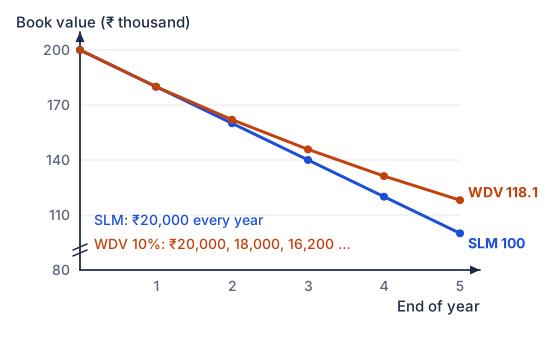
Straight Line Method (SLM) — equal charge every year (fixed instalment method).
Depreciation = (Cost − Estimated net residual value) ÷ Estimated useful life
Written Down Value Method (WDV) — a fixed percentage on the opening book value, so the charge falls each year (reducing balance method).
Rate R = [1 − (s/c)^(1/n)] × 100, where s = scrap value, c = cost, n = useful life
7.7 SLM vs WDV
SLM charges the same amount each year; WDV charges a fixed % of a shrinking balance, so the charge falls.
Basis: original cost (SLM) vs book value (WDV).
Annual charge: constant (SLM) vs declining (WDV).
Depreciation + repairs together: rises in later years (SLM) vs roughly equal (WDV).
Income Tax: SLM not recognised; WDV recognised.
Suitability: SLM for land and buildings, patents, trademarks; WDV for plant, machinery and vehicles.
7.8 Recording depreciation
Charging depreciation to the asset account — Depreciation A/c Dr, To Asset A/c; then P&L A/c Dr, To Depreciation A/c. The asset appears at book value.
Provision for depreciation (accumulated depreciation) account — Depreciation A/c Dr, To Provision for Depreciation A/c; then P&L A/c Dr, To Depreciation A/c. The asset stays at original cost; the accumulated provision is deducted from it or shown on the liabilities side.
7.9 Disposal
On sale, the provision is first transferred to the asset account (Provision for Depreciation A/c Dr, To Asset A/c); the sale proceeds are credited, and the balance is profit or loss. An Asset Disposal Account collects cost, accumulated depreciation, sale proceeds and profit/loss in one place.
7.10 Additions and extensions
Additions that become an integral part of the asset are capitalised and depreciated over its useful life. Routine maintenance is revenue expenditure.
Key Concepts — Section II: Provisions and Reserves
7.11 Provisions
A charge against profit for a known expense or loss of uncertain amount — e.g. provision for depreciation, bad and doubtful debts, taxation, discount on debtors, and repairs and renewals. Created by debiting P&L (prudence/conservatism). Shown as a deduction from the asset or with current liabilities.
7.12 Reserves
An appropriation of profit to strengthen the business — e.g. general reserve, workmen compensation fund, investment fluctuation fund, capital reserve, dividend equalisation reserve, debenture redemption reserve. Shown under Reserves and Surplus after capital.
Provision vs Reserve: charge against profit vs appropriation of profit; for a known liability vs to strengthen the business; reduces taxable profit vs no effect on taxable profit.
Types: General reserve (free); specific reserves; revenue reserves (from operating profits); capital reserves (from capital profits such as premium on issue of shares, profit on sale of fixed assets, profit prior to incorporation — not available for dividend).
7.13 Secret Reserve
A reserve that does not appear in the balance sheet, created by excess depreciation, undervaluing stock, charging capital expenditure to P&L, excessive provisions, or showing contingent liabilities as actual.
Worked Examples (figures verified)
SLM: cost ₹2,50,000, residual ₹50,000, life 10 years
SLM: fixed amount; WDV: fixed rate on a falling balance.
Income-tax law recognises WDV, not SLM.
Provision = charge against profit; Reserve = appropriation of profit.
Capital profits → capital reserve (not for dividend).
Exam Focus
Compute SLM and WDV depreciation, including part-year assets; prepare asset, provision-for-depreciation and disposal accounts.
Differentiate SLM vs WDV, provision vs reserve, and revenue vs capital reserve.
Explain causes and need of depreciation and the meaning of secret reserve.
Key Terms
Depreciation (मूल्य ह्रास)
Depletion (अवक्षय)
Amortisation (परिशोधन)
Obsolescence (अप्रचलन)
Residual/scrap value (अवशिष्ट मूल्य)
Useful life (उपयोगी जीवन)
Straight line method (सीधी रेखा विधि)
Written down value method (क्रमागत ह्रास विधि)
Provision (प्रावधान)
Reserve (संचय)
General reserve (सामान्य संचय)
Capital reserve (पूंजी संचय)
Secret reserve (गुप्त संचय)
Asset disposal account (परिसंपत्ति निपटान खाता)
Common Mistakes
Leaving installation and freight out of cost.
Charging a full year's depreciation on an asset bought mid-year (use months).
Applying the WDV rate to original cost instead of the opening book value.
Calling a reserve a charge against profit.
💡 Key Learning Points
✓Define depreciation, depletion and amortisation and state causes of depreciation
✓Compute depreciation by SLM and WDV, including part-year assets
✓Record depreciation by charging the asset account or through provision for depreciation
✓Prepare asset and disposal accounts and find profit or loss on sale
✓Distinguish provision from reserve, and revenue from capital reserve
👨🏫 Teaching Tips
→Plot SLM and WDV charges on the same graph so students see the straight vs curved pattern
→Have students build a year-by-year depreciation schedule in their notebooks before ledger work
→Use a real item (a school printer) to estimate cost, life and scrap value
→Show both recording methods side by side for the same asset
→Practise month counting for mid-year purchases with a timeline
→Use a T-chart to contrast provisions and reserves
→Discuss why companies may prefer WDV for machinery
📋 Assessment Questions
Calculate annual SLM depreciation and rate from cost, scrap and life
Prepare a WDV schedule for three years
Find profit or loss on sale of an asset after depreciation
Differentiate a provision from a reserve with examples
Ask the AI tutor about Class 11 Accountancy Chapter 7
Get question answers, important questions, a quick MCQ quiz or a simple explanation of “Depreciation, Provisions and Reserves”. Free — sign in with Google.
Depreciation, Provisions and Reserves – question answers
2 questions
Questions students asked about this chapter, answered and checked by TalentJR.
Q
How to make a ledger?
A
Creating a ledger is an essential part of accounting, where you record all transactions related to a specific account. Here’s a simple step-by-step guide to help you make a ledger:
Steps to Create a Ledger
Choose the Ledger Account:
Decide which account you want to create a ledger for (e.g., Cash, Sales, Purchases, etc.).
Draw the Ledger Format:
A ledger typically has two sides: the Debit side (left) and the Credit side (right).
Create columns for the date, details, reference (like voucher number), debit amount, credit amount, and balance.
A x ltd accquired a m/c for 40,000 on 1/7/14 and spent 5000 on its installation. Another m/c was purchased on 1/1/2016 costing 35,000. one forth of the m/c purchased on 1/7/2014 was sold on 1/1/2019 for 3000. calculate depriciation at 10%p.a. and to be charged as per wdv. calculate loss or gain
A
From your chapter:
Cost of the first machine (1/7/2014):
Machine cost: ₹40,000
Installation cost: ₹5,000
Total cost = ₹40,000 + ₹5,000 = ₹45,000
Depreciation calculation using WDV method:
First machine:
Depreciation rate = 10%
Year 1 (1/7/2014 to 31/3/2015):
Depreciation = 10% of ₹45,000 = ₹4,500
WDV at 31/3/2015 = ₹45,000 - ₹4,500 = ₹40,500
Year 2 (2015-2016):
Depreciation = 10% of ₹40,500 = ₹4,050
WDV at 31/3/2016 = ₹40,500 - ₹4,050 = ₹36,450
Year 3 (2016-2017):
Depreciation = 10% of ₹36,450 = ₹3,645
WDV at 31/3/2017 = ₹36,450 - ₹3,645 = ₹32,805
Year 4 (2017-2018):
Depreciation = 10% of ₹32,805 = ₹3,280.50
WDV at 31/3/2018 = ₹32,805 - ₹3,280.50 = ₹29,524.50
Year 5 (2018-2019):
Depreciation = 10% of ₹29,524.50 = ₹2,952.45
WDV at 31/12/2018 = ₹29,524.50 - ₹2,952.45 = ₹26,572.05
Sale of 1/4 of the first machine:
WDV of 1/4 of the machine = ₹26,572.05 / 4 = ₹6,643.01
Sold for: ₹3,000
Loss on sale = WDV - Sale price = ₹6,643.01 - ₹3,000 = ₹3,643.01 (loss)
👩🏫 Class 11 Accountancy classes near you — online or at home
Prefer a real teacher? TalentJR teachers take live online classes anywhere in India and visit homes in selected cities. Tell us what you need and our team will call you with timings and fees.
💻Live online classesSmall groups or 1:1 with a teacher, from home, any city.
🏠Teacher at homeA TalentJR teacher visits your home (selected cities).
🏫At a centreClasses at a TalentJR partner centre near you, where available.