Notes and a simple summary of Chapter 6 of the NCERT Class 10 Science book, with the official chapter PDF, flashcards, an MCQ quiz and an AI tutor for your doubts.
🎧 Listen to the content
Summary: Control and Coordination
Introduction
When we see a tasty dish, our mouth waters; when we touch something hot, we pull our hand back at once. Living organisms respond to changes in the environment in carefully controlled ways. In animals this control and coordination is done by two systems working together — the nervous system (electrical impulses) and the endocrine system (chemical messengers called hormones). Plants, which have no nervous system, also coordinate their responses using chemical signals.
Key Concepts
1. Nervous system in animals
Information from the environment is detected by receptors in sense organs — e.g., gustatory receptors (taste) in the tongue and olfactory receptors (smell) in the nose. A neuron (nerve cell) is the unit of the nervous system:
The dendrite tip picks up information and sets off a chemical reaction that creates an electrical impulse.
The impulse travels from dendrite → cell body → along the axon to its end.
At the end of the axon, the electrical impulse releases chemicals that cross a gap called the synapse and start a new impulse in the dendrite of the next neuron.
Similar synapses deliver impulses from neurons to muscle or gland cells.
2. Reflex actions and the reflex arc
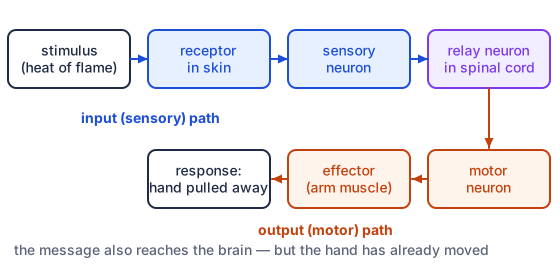
A reflex arc short-cuts through the spinal cord, so the response comes before you think.
A reflex action is a sudden, automatic response to a stimulus, done without thinking — like pulling the hand away from a flame. Thinking would take too long, so the body uses a shorter pathway called a reflex arc:
Receptor → sensory neuron → relay neuron in the spinal cord → motor neuron → effector (muscle)
Reflex arcs are formed in the spinal cord, where input nerves meet output nerves. Information also reaches the brain, but the response has already happened.
3. Human brain
The brain and spinal cord form the central nervous system (CNS). The peripheral nervous system consists of cranial nerves (from the brain) and spinal nerves (from the spinal cord). The brain has three regions:
Fore-brain — the main thinking part; has sensory areas for hearing, smell, sight etc., association areas that interpret information, and motor areas controlling voluntary muscles. The centre for hunger/feeling full is also in a separate part of the fore-brain.
Mid-brain — controls some involuntary actions such as reflex movements of the head, neck and trunk (as per NCERT's description).
Hind-brain — has the medulla, which controls involuntary actions such as blood pressure, salivation and vomiting; and the cerebellum, responsible for precision of voluntary actions and maintaining posture and balance (e.g., walking in a straight line, riding a bicycle, picking up a pencil).
The brain is protected inside a bony box (the skull) and cushioned by a fluid-filled balloon; the spinal cord is protected by the vertebral column.
4. How nervous tissue causes action
Muscle cells move when special proteins in them change their shape and arrangement in response to nervous impulses, making the muscle cell shorter.
5. Coordination in plants
Plants use two kinds of movement:
Immediate response to stimulus (not growth) — the leaves of the sensitive plant (Mimosa pudica, chhui-mui) fold when touched. Cells change shape by changing the amount of water in them, so they swell or shrink.
Movement due to growth (directional, called tropisms):
- Phototropism — shoots bend towards light, roots away from it.
- Chemotropism — response to chemicals, e.g., growth of pollen tubes towards ovules.
- Tendrils — the part touching a support grows less rapidly than the part away from it, so the tendril coils around the support.
Plant hormones:
Auxin — made at the shoot tip; when light comes from one side it diffuses towards the shady side, making cells there grow longer, so the shoot bends towards light.
Gibberellins — help growth of the stem.
Cytokinins — promote cell division; present in high concentration in areas of rapid cell division such as fruits and seeds.
Abscisic acid — inhibits growth; causes wilting of leaves.
6. Hormones in animals
Hormones are secreted by endocrine glands directly into the blood and act on target cells. The book's Table 6.1 lists:
Growth hormone — pituitary gland — stimulates growth in all organs; deficiency in childhood causes dwarfism.
Thyroxin — thyroid gland — regulates carbohydrate, protein and fat metabolism; needs iodine; iodine deficiency can cause goitre (swollen neck), which is why iodised salt is advised.
Insulin — pancreas — regulates blood sugar; lack of it causes diabetes.
Testosterone — testes — changes at puberty in males.
Oestrogen — ovaries — development of female sex organs, regulates the menstrual cycle.
Adrenaline — adrenal gland — prepares the body for emergencies: heart beats faster, blood is diverted to skeletal muscles, breathing rate increases.
Releasing hormones — hypothalamus — stimulate the pituitary to release hormones (e.g., growth hormone releasing factor).
Feedback mechanism — the timing and amount of hormones are regulated. If blood sugar rises, pancreatic cells detect it and produce more insulin; as sugar falls, insulin secretion is reduced.
Diagrams to Draw (described in words)
Neuron: dendrites branching from the cell body (with nucleus), a long axon ending in nerve endings.
Reflex arc: receptor in skin → sensory neuron → spinal cord (relay neuron) → motor neuron → muscle.
Human brain: fore-brain (cerebrum), mid-brain, hind-brain with cerebellum, pons and medulla, and the pituitary gland below.
Phototropism set-up: germinating seeds on a wire mesh over a flask of water inside a box open on one side.
Activities in the Chapter
Activity 6.1 — Taste sugar with and without blocking the nose; food tastes different because smell and taste work together.
Activity 6.2 — Germinated bean seeds on a flask in a box open to light: shoots bend towards light and roots away; turning the flask makes new growth bend again — phototropism.
Activity 6.3 / 6.4 — Identify the endocrine glands in Fig. 6.7 and complete Table 6.1 of hormones, glands and functions.
Board Exam Focus
Draw and label a neuron; explain what happens at a synapse.
Explain a reflex arc and why reflexes are processed in the spinal cord.
Functions of the medulla, cerebellum and fore-brain.
Plant hormones and tropisms; movement of Mimosa vs tendrils.
Iodised salt, insulin and adrenaline questions; feedback mechanism.
Key Terms
Neuron (तंत्रिका कोशिका) — nerve cell
Synapse (सिनैप्स/अंतर्ग्रथन) — gap between two neurons
👩🏫 Class 10 Science classes near you — online or at home
Prefer a real teacher? TalentJR teachers take live online classes anywhere in India and visit homes in selected cities. Tell us what you need and our team will call you with timings and fees.
💻Live online classesSmall groups or 1:1 with a teacher, from home, any city.
🏠Teacher at homeA TalentJR teacher visits your home (selected cities).
🏫At a centreClasses at a TalentJR partner centre near you, where available.