Notes and a simple summary of Chapter 2 of the NCERT Class 5 Mathematics book, with the official chapter PDF, flashcards, an MCQ quiz and an AI tutor for your doubts.
🎯 What is your exam target?
Set a target % — TalentJR plans your practice and tracks your progress.
Tamanna has two chocolates of different sizes. She says ½ of one chocolate is bigger than ⅓ of the other. Is she right? It depends on the chocolates! The chapter's first big lesson:
To compare two fractions, the wholes must be the same.
Then we play with grids, a fraction kit, parathas, pizzas and number lines to learn equivalent fractions, comparing fractions and fractions greater than 1.
Key Ideas
1. Equivalent fractions
Multiply top and bottom by the same number to get an equivalent fraction.
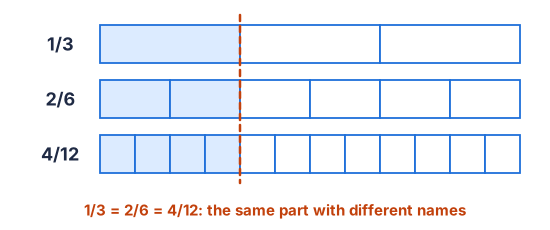
Shade ⅙ of a grid and 2/6 of it is the same as ⅓. Fractions that show the same part of a whole with different names are equivalent fractions.
Gurpreet's fraction kit: one ½ piece = two ¼ pieces, so ½ = 2/4.
Sameer divides ⅓ of shapes into more parts: 1/3 = 2/6 = 3/9 = 4/12.
Similarly 2/5 = 4/10 = 20/50 = 40/100.
Multiply the top and bottom by the same number to get an equivalent fraction.
2. Comparing — same denominator
Sevi ate ⅓ of a chikki and Shami ate ⅔. Two pieces of ⅓ are more than one piece, so ⅔ > ⅓ — Shami ate more.
3. Comparing — same numerator
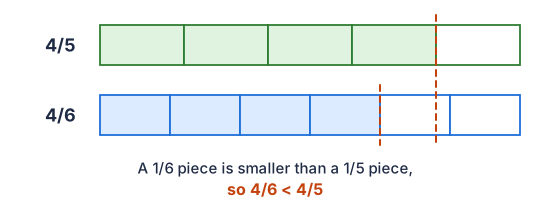
Same numerator: the bigger denominator gives smaller pieces, so the smaller fraction.
Sevi ate 4/5 paratha, Shami ate 4/6. A ⅙ piece is smaller than a ⅕ piece, so 4/6 < 4/5. With the same numerator, the bigger denominator gives the smaller fraction.
4. Fractions greater than 1
Raman's father cuts parathas into halves or fourths.
Maa takes 5 half pieces: 5/2 = 2 + ½ = 2½ parathas.
Radhika takes 6 halves: 6/2 = 3 parathas.
Dadiji takes 9 fourths: 9/4 = 2¼ parathas.
We can show these on a number line by marking halves or fourths beyond 1.
5. Using 1 and ½ as benchmarks
7/8 is less than 1 and 8/6 is more than 1, so 7/8 < 8/6.
3/6 is exactly half, but 5/8 is more than half, so 5/8 > 3/6.
Worked Examples
Fill in: 1/3 = ?/36 → 3 × 12 = 36, so 1 × 12 = 12 → 12/36.
Compare 3/8 and 3/7 → same numerator; eighths are smaller than sevenths, so 3/8 < 3/7.
Pizza story: 2 pizzas cut into 3 slices each. Dadiji and Dadaji give their slices to Raman → Raman has 3/3 = 1 whole pizza. He gives one slice to Radhika, who already had 3/3, so Radhika has 4/3 = 1⅓ pizzas.
Parathas in fourths: Raman 7/4 = 1¾, Radhika 6/4 = 1½, Maa 8/4 = 2, Dadiji 10/4 = 2½, Baba 12/4 = 3. Total = 43/4 = 10¾ parathas.
Ants in a line: one ant is ¼ cm long, so 16 ants = 16/4 = 4 cm.
Maths Words
Fraction (भिन्न)
Numerator (अंश)
Denominator (हर)
Equivalent fractions (तुल्य भिन्न)
Whole (पूर्ण)
Half (आधा), Quarter/One-fourth (चौथाई)
Number line (संख्या रेखा)
Greater than / Less than (से बड़ा / से छोटा)
Maths in Daily Life
Sharing chikki, cutting parathas and pizzas, measuring ribbon in half metres, and reading "½ kg" on packets all use fractions.
Common Mistakes
Thinking 4/6 > 4/5 because 6 > 5. With equal numerators, smaller pieces mean a smaller fraction.
Comparing fractions of different-sized wholes, like Tamanna's chocolates.
Changing only the numerator or only the denominator when making equivalent fractions.
Forgetting that 6/2 is a whole number (3).
Practice Tips
Use the fraction kit at the back of the book to check every answer.
To circle fractions greater than 1, check if the numerator is bigger than the denominator.
To check for "half", see if the denominator is double the numerator (5/10, 7/14, 8/16).
💡 Key Learning Points
✓Fractions can only be compared when they are parts of the same whole
✓Equivalent fractions name the same part: 1/3 = 2/6 = 3/9 = 4/12
✓With the same denominator, the bigger numerator is bigger; with the same numerator, the bigger denominator is smaller
✓Fractions like 5/2 and 9/4 are greater than 1 and can be written as 2½ and 2¼
✓1 and ½ are useful benchmarks for comparing fractions quickly
👨🏫 Teaching Tips
→Show two chocolates or rotis of different sizes and ask whether ½ of the small one can be less than ⅓ of the big one
→Let groups make a whole in many ways with the fraction kit and record equivalent fractions
→Fold paper strips into halves, fourths and eighths to see ½ = 2/4 = 4/8
→Act out Raman's family meal with paper parathas cut into halves and fourths, then mark each share on a number line
→Play 'Is it more than half?' — show a fraction card, children stand if it is more than ½
→Use the pizza story to practise adding thirds beyond one whole
→Draw a floor number line from 0 to 3 and let children hop in quarters
📋 Assessment Questions
Can the child find two fractions equivalent to 2/5?
Can the child explain why 4/6 < 4/5 using pieces of the fraction kit?
Can the child write 9/4 as a mixed number and show it on a number line?
Can the child compare 7/8 and 8/6 using 1 as a benchmark?
Can the child circle fractions equal to ½ from a list?
Ask the AI tutor about Class 5 Mathematics Chapter 2
Get question answers, important questions, a quick MCQ quiz or a simple explanation of “Fractions”. Free — sign in with Google.
Fractions are a way to show parts of a whole. For example, if you have a pizza and you cut it into 4 equal slices, taking 1 slice can be written as 1/4. Here, 1 is the part you have, and 4 is the total number of equal parts in the whole pizza.
The top number of a fraction is called the numerator, and it tells how many parts you have. The bottom number is called the denominator, and it tells how many equal parts the whole is divided into.
Fractions can be equivalent, which means they look different but represent the same amount. For example, 1/2 is the same as 2/4.
You can compare fractions to see which is bigger or smaller. If they have the same denominator, the one with the bigger numerator is larger. If they have the same numerator, the one with the smaller denominator is larger.
Extra help: Think of fractions like sharing a chocolate bar. If you share it with 2 friends, each gets 1/3 of the bar. If you share it with 4 friends, each gets 1/4 of the bar. The more friends you share with, the smaller the piece each one gets!
👩🏫 Class 5 Mathematics classes near you — online or at home
Prefer a real teacher? TalentJR teachers take live online classes anywhere in India and visit homes in selected cities. Tell us what you need and our team will call you with timings and fees.
💻Live online classesSmall groups or 1:1 with a teacher, from home, any city.
🏠Teacher at homeA TalentJR teacher visits your home (selected cities).
🏫At a centreClasses at a TalentJR partner centre near you, where available.