Notes and a simple summary of Chapter 2 of the NCERT Class 6 Social Science book, with the official chapter PDF, flashcards, an MCQ quiz and an AI tutor for your doubts.
🎯 What is your exam target?
Set a target % — TalentJR plans your practice and tracks your progress.
What are oceans and continents? What are their names and their distribution?
In what ways do oceans and continents impact life on Earth, including human life?
"The ocean is everything. It covers seven-tenths of the terrestrial globe. Its breath is pure and healthy. ... The ocean is the vast reservoir of Nature." — Jules Verne (1870)
Introduction
Look at the photograph of the Earth taken from space (Fig. 2.1), centred on the Indian Ocean. Africa is to the left, India and Asia are at the top, Australia is to the right and Antarctica is at the bottom. The most widespread colour is blue, which is water. Water covers almost three-fourths of the Earth's surface, so early astronauts lovingly called the Earth the 'blue planet'. The brown patches are land, a little over one-fourth of the globe.
The largest water bodies are oceans.
A large body of land is a landmass. A large continuous expanse of land is a continent.
Did you know? The Indian Navy's motto is Śham no Varuṇah, "Be auspicious to us, O Varuna", an invocation to the Vedic deity of oceans, sky and water.
Key Concepts
1. Distribution of water and land
Maps drawn from above the North Pole and the South Pole (Fig. 2.2) show that land and water are not equally distributed. The Northern Hemisphere has more land, and the Southern Hemisphere has more water. Oceans have smaller extensions called seas, bays and gulfs.
Ocean water is salty and unfit for most land animals to drink.
Freshwater is a very small share. It is found in glaciers, rivers, lakes, the atmosphere and underground (groundwater).
2. The five oceans
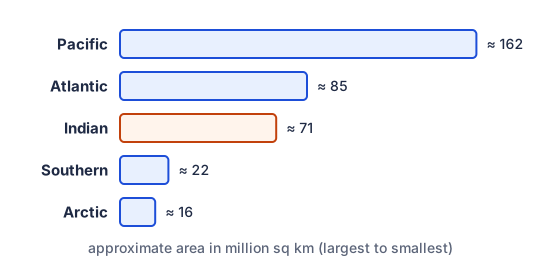
The Pacific is by far the largest ocean and the Arctic the smallest; India lies on the Indian Ocean.
From largest to smallest:
Pacific Ocean (largest)
Atlantic Ocean
Indian Ocean
Southern (Antarctic) Ocean
Arctic Ocean (smallest)
The lines dividing oceans are only conventions; seawater flows freely across them. Oceans are home to marine flora (algae, seaweeds) and marine fauna (fish, dolphins, whales, sea turtles, emperor penguins, coral-reef life, deep-sea creatures).
The Indian Ocean is bounded by Asia to the north, Africa to the west, Australia to the east and the Southern Ocean to the south. On either side of India are the Arabian Sea (west) and the Bay of Bengal (east).
3. Oceans and disasters
Clouds formed over oceans bring rain; India's monsoon rains come from the ocean.
Oceans also cause cyclones: storms with extreme rain and strong winds.
A tsunami is a huge wave, usually caused by an undersea earthquake or volcanic eruption.
On 26 December 2004, an earthquake in Indonesia caused a tsunami that struck India and 13 other countries. More than two lakh people died. The Andaman and Nicobar Islands and the coasts of Tamil Nadu and Kerala were badly hit.
The Indian Ocean Tsunami Warning System gives early warnings. India's National Disaster Management Authority handles disasters.
4. Continents: how many?
Continents can be counted as four to seven, depending on how we group landmasses:
Four: Africa-Eurasia, America, Antarctica, Australia
Six: Africa, Antarctica, Australia, Eurasia, North America, South America
Seven (most widely used): Africa, Antarctica, Asia, Australia, Europe, North America, South America
Europe and Asia are one landmass. They are called two continents for historical and cultural reasons, but geologists often call them Eurasia. The five Olympic rings stand for five inhabited continents: Africa, America, Asia, Australia and Europe. The book's square diagram shows Asia as the largest and Australia as the smallest continent.
5. Islands
Islands are smaller landmasses surrounded by water on all sides. Continents are also surrounded by water but are too large to count as islands.
Greenland is the largest island in the world, as big as India's 10 largest states put together.
India has more than 1,300 islands. The two major groups are the Andaman and Nicobar Islands (Bay of Bengal) and Lakshadweep (Arabian Sea).
India in Antarctica: The Indian Antarctica Programme began in 1981. India set up its first research station, Dakshin Gangotri, in 1983 (two more came later). About 40 teams of scientists have studied the climate there, and the settlement even has a library and a post office!
6. Oceans and life
Without oceans there would be no rainfall, and the Earth would be a desert (the water cycle).
More than half of the world's oxygen is produced by ocean flora, so oceans are called 'the planet's lungs'.
People have used oceans for migration, trade, military campaigns and fishing. Coastal cultures have tales of sea gods, monsters and treasures.
The UN marks 8 June as World Oceans Day.
The threats are plastic pollution (millions of tonnes every year) and overfishing. Protecting oceans is our collective responsibility.
Activities in the Chapter
On the polar maps, name the circular lines (parallels) and radiating lines (meridians), and decide which hemisphere holds more water.
Fill in a table showing which hemisphere(s) each ocean lies in.
Count squares in the continent diagram to rank continents by size, then recolour Europe + Asia as "Eurasia".
Think about it: If the planet has so much water, why do we talk of a "water crisis"? (Most of it is salty; freshwater is scarce.)
Key Terms
Ocean (महासागर): the largest water bodies on Earth
Continent (महाद्वीप): a large continuous expanse of land
Landmass (भूभाग): a large body of land
Island (द्वीप): land surrounded by water on all sides, smaller than a continent
Marine (समुद्री): related to or found in oceans and seas
Flora (वनस्पति): plant life of a region
Fauna (जीव-जंतु): animal life of a region
Groundwater (भूजल): freshwater found underground
Tsunami (सुनामी): huge destructive ocean wave
Cyclone (चक्रवात): violent storm with strong winds and heavy rain
Eurasia (यूरेशिया): Europe and Asia seen as one continent
Overfishing (अत्यधिक मत्स्यन): excessive fishing
Hemisphere (गोलार्ध): half of the Earth
Connect to Today
The monsoon that waters Indian farms begins over the ocean. Every plastic bottle thrown away can end up choking marine life.
Common Mistakes
Saying there are always exactly seven continents. The count can be 4 to 7; seven is simply the most common.
Calling Australia an island. It is counted as a continent; Greenland is the largest island.
Thinking the Indian Ocean is larger than the Atlantic. The order is Pacific > Atlantic > Indian > Southern > Arctic.
Thinking oceans are separate. They are all connected.
Questions and Activities: Hints
Q1: define continent, ocean and island in your own words, using the chapter's definitions. The crossword answers include oxygen, Greenland, continent, Asia, plastic, Antarctica, tsunami, Australia, Pacific and island.
💡 Key Learning Points
✓Water covers almost three-fourths of the Earth, which is why it is called the 'blue planet'; most of this water is salty and freshwater is scarce.
✓The five oceans in order of size are the Pacific, Atlantic, Indian, Southern and Arctic, and they are all interconnected.
✓Continents can be counted as four to seven; the most common list has seven, with Asia the largest and Australia the smallest.
✓The Northern Hemisphere has more land than the Southern Hemisphere; Greenland is the largest island and India has over 1,300 islands.
✓Oceans give rain and more than half of the world's oxygen, but also bring cyclones and tsunamis, and they now suffer from plastic pollution and overfishing.
👨🏫 Teaching Tips
→Open with the 'blue planet' photo (Fig. 2.1) and ask students to estimate the share of blue versus brown before revealing 'almost three-fourths'.
→Use an inflatable globe toss: wherever a student's right thumb lands, record 'water' or 'land'; after 30 throws, compare with three-fourths.
→Let groups make paper-square models of the seven continents from the diagram and rank them by size.
→Discuss the 2004 tsunami with a map of affected Indian coasts and explain how early-warning systems save lives.
→Run a classroom debate: 'How many continents are there?', with teams defending the 4, 5, 6 and 7 counts.
→Connect to Science: show the water cycle and explain why oceans are called 'the planet's lungs'.
→Hold a mini 'World Oceans Day' (8 June) poster activity on plastic pollution and overfishing.
→Label the five oceans and seven continents on the outline world map given in the exercises.
📋 Assessment Questions
Can the student name and rank the five oceans by size and locate them on a world map?
Can the student explain why continents can be counted in different ways (4 to 7)?
Can the student state which hemisphere has more land and which has more water?
Can the student describe two ways oceans support life and two dangers linked to oceans?
Can the student name India's two major island groups and the seas on either side of India?
Ask the AI tutor about Class 6 Social Science Chapter 2
Get question answers, important questions, a quick MCQ quiz or a simple explanation of “Oceans and Continents”. Free — sign in with Google.
Pacific Ocean: Yeh ocean itna bada hai ki isme kai islands hain, jaise Hawaii.
Asia: Yeh continent sabse bada hai aur yahan India, China jaise bade desh hain.
Importance:
Oceans aur continents dono hi zindagi ke liye bahut zaroori hain. Oceans humein paani, khana (fishing), aur transport provide karte hain. Continents par hum rehne, kaam karne aur school jaane ke liye hote hain.
Agar aapko koi specific point ya topic samajhna hai, toh bataiye!
👩🏫 Class 6 Social Science classes near you — online or at home
Prefer a real teacher? TalentJR teachers take live online classes anywhere in India and visit homes in selected cities. Tell us what you need and our team will call you with timings and fees.
💻Live online classesSmall groups or 1:1 with a teacher, from home, any city.
🏠Teacher at homeA TalentJR teacher visits your home (selected cities).
🏫At a centreClasses at a TalentJR partner centre near you, where available.