Notes and a simple summary of Chapter 5 of the NCERT Class 9 Mathematics book, with the official chapter PDF, flashcards, an MCQ quiz and an AI tutor for your doubts.
🎯 What is your exam target?
Set a target % — TalentJR plans your practice and tracks your progress.
Circles are everywhere in nature — ripples when raindrops hit water, the cross-section of a plant stem, a sunflower head, the full moon. Even the Gudahandi cave paintings in Odisha show circles and other geometric shapes. This chapter turns our everyday observation that every circle has a centre equally far from all its points into a definition, and then uses it to discover a chain of beautiful theorems.
A circle is the set (locus) of all points in a plane that are equidistant from a given point, the centre. The common distance is the radius. A segment joining two points of the circle is a chord; a chord through the centre is a diameter.
Key Ideas
Symmetries of a circle (5.2)
Complete rotational symmetry: rotate a circle about its centre by any angle and it looks the same (like a turning wheel).
Reflection symmetry: every diameter is a line of symmetry — fold a paper circle so the edges overlap and the crease passes through the centre.
How many circles? (5.3)
The locus of points equidistant from A and B is the perpendicular bisector of AB. So infinitely many circles pass through two points; their centres all lie on that perpendicular bisector. The smallest has AB as diameter.
Theorem 1: Exactly one circle passes through three non-collinear points. Its centre is where the perpendicular bisectors of AB and AC meet. No circle passes through three collinear points.
This circle is the circumcircle of triangle ABC and its centre is the circumcentre: inside an acute triangle, outside an obtuse triangle, and at the midpoint of the hypotenuse of a right triangle.
Chords and angles at the centre (5.4)
Theorem 2: Equal chords subtend equal angles at the centre (SSS congruence of the two centre triangles).
Theorem 3 (converse): Chords subtending equal angles at the centre are equal (SAS congruence).
Midpoints and perpendiculars (5.5)
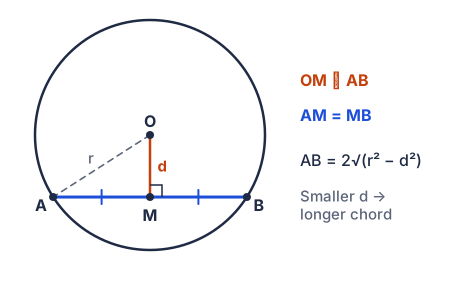
The perpendicular from the centre bisects the chord, so AB = 2√(r² − d²).
Theorem 4: The line from the centre to the midpoint of a chord is perpendicular to the chord (SAS, and two equal angles on a line are each 90°).
Theorem 5: The perpendicular from the centre to a chord bisects it.
Distance of chords from the centre (5.6)
Theorem 6: Equal chords are equidistant from the centre (SSS or RHS congruence).
Theorem 7: Chords equidistant from the centre are equal.
Theorem 8: The longer chord is closer to the centre (Baudhāyana–Pythagoras: CF² + AF² = CG² + GD²). The diameter, at distance 0, is the longest chord.
Useful formula: a chord at distance d from the centre of a circle of radius r has length 2√(r² − d²).
Angles subtended by an arc (5.7)
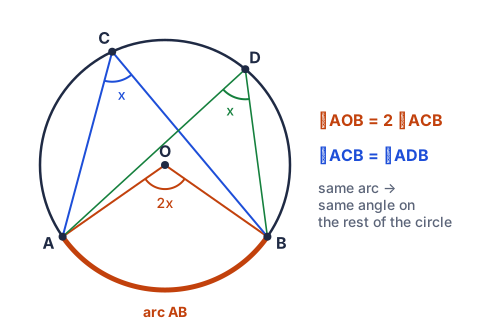
Angle at the centre is double the angle at the circumference; angles on the same arc are equal.
An arc's two parts: the minor arc (angle at centre < 180°) and major arc (> 180°).
Theorem 9: The angle an arc subtends at the centre is double the angle it subtends at any point on the remaining part of the circle (proved with isosceles triangles and the exterior angle theorem, in two cases).
So all angles subtended by the same arc at points on the rest of the circle are equal.
Corollary: The angle in a semicircle (subtended by a diameter) is 90°.
Concyclic points and cyclic 4-gons (5.8)
Theorem 10: If segment AB subtends equal angles at C and D on the same side of AB, then A, B, C, D are concyclic.
Theorem 11: In a cyclic quadrilateral, opposite angles add up to 180°.
Theorem 12 (converse): If a pair of opposite angles of a quadrilateral add up to 180°, it is cyclic.
Worked Examples
Chord length: radius 13 cm, chord 5 cm from the centre. Half-chord = √(13² − 5²) = √144 = 12, so the chord is 24 cm.
Distance from centre: diameter 26 cm (r = 13), chord 24 cm. Distance = √(13² − 12²) = 5 cm.
Radius from a chord: chord 16 cm at distance 6 cm. r = √(8² + 6²) = 10 cm.
Parallel chords: chords 6 cm and 8 cm on opposite sides of the centre of a circle of radius 5 cm. Distances are √(25 − 9) = 4 cm and √(25 − 16) = 3 cm, so the midpoints are 7 cm apart.
Arc angle: an arc subtends 70° at the centre, so it subtends 35° at any point on the rest of the circle.
The Baudhāyana–Pythagoras theorem is the key tool for chord distances (Theorem 8 and the chord-length formula).
Early circular patterns in the Gudahandi cave paintings (Odisha) show how long humans have been drawn to this shape.
Common Mistakes
Thinking a circle can pass through three collinear points — it cannot.
Assuming the circumcentre is always inside the triangle.
Forgetting that the perpendicular from the centre bisects the chord, so using the full chord instead of half in Pythagoras.
Mixing up which arc is meant; the angle at the circle is half the angle of the arc not containing that point.
Saying all opposite angles of any quadrilateral add to 180° — only cyclic ones do.
Maths in Daily Life
Wheels, gears and clock faces rely on rotational symmetry; locating the centre of a round table-top, a well or a broken plate uses perpendicular bisectors; engineers use chord–radius relations to design arches and bridges.
💡 Key Learning Points
✓A circle is the locus of points equidistant from a centre; it has complete rotational symmetry and every diameter is a line of symmetry.
✓Infinitely many circles pass through two points, exactly one through three non-collinear points (the circumcircle), none through three collinear points.
✓Equal chords ⇔ equal angles at the centre ⇔ equal distances from the centre; the perpendicular from the centre bisects a chord.
✓The angle an arc makes at the centre is twice the angle at any point on the rest of the circle; the angle in a semicircle is 90°.
✓Opposite angles of a cyclic quadrilateral add to 180°, and the converse identifies cyclic quadrilaterals.
👨🏫 Teaching Tips
→Begin with paper-circle folding: find diameters as creases and locate the centre by intersecting two perpendicular bisectors.
→Use the 'rotating wheel with a thread chord' model to motivate Theorems 2 and 3.
→Let students draw acute, obtuse and right triangles with their circumcircles and classify where the circumcentre falls.
→Record chord length vs distance from centre in a class table before proving Theorem 8.
→Use GeoGebra or a protractor activity: measure angles subtended by one arc at several points on the circle.
→Stress 'Given / To show / Why is this true' structure for every proof, as the book does.
→Give the 80°, 110°, 100°, 70° quadrilateral as a discussion question on cyclic quadrilaterals.
📋 Assessment Questions
Find the chord length when radius and distance from centre are known, and vice versa.
Explain why exactly one circle passes through three non-collinear points.
Prove that the perpendicular from the centre bisects a chord.
Find unknown angles using the arc-angle theorem and the cyclic quadrilateral property.
Show that a rectangle is the only parallelogram that can be inscribed in a circle.
Ask the AI tutor about Class 9 Mathematics Chapter 5
Get question answers, important questions, a quick MCQ quiz or a simple explanation of “I’m Up and Down, and Round and Round”. Free — sign in with Google.
I’m Up and Down, and Round and Round – question answers
1 question
Questions students asked about this chapter, answered and checked by TalentJR.
Q
Explain I’m Up and Down, and Round and Round in simple words
A
The chapter "I’m Up and Down, and Round and Round" is all about circles. Here’s a simple breakdown:
What is a Circle?
A circle is a shape made up of all the points that are the same distance (called the radius) from a central point (called the centre).
Symmetry of Circles:
Circles look the same no matter how you turn them (this is called rotational symmetry).
If you fold a circle in half along any diameter, both sides will match perfectly (this is called reflection symmetry).
Circles and Points:
You can draw many circles through two points, but only one circle can go through three points that are not in a straight line (non-collinear points). This circle is called the circumcircle, and its centre is called the circumcentre.
Chords and Angles:
A chord is a line segment that connects two points on the circle. If two chords are equal in length, they make the same angle at the centre of the circle.
The line from the centre to the midpoint of a chord is always at a right angle (90 degrees) to that chord.
Angles and Arcs:
The angle that an arc makes at the centre of the circle is double the angle it makes at any other point on the circle.
Cyclic Quadrilaterals:
A cyclic quadrilateral is a four-sided figure where opposite angles add up to 180 degrees.
This chapter helps us understand the properties and relationships of circles, which are important in geometry!
👩🏫 Class 9 Mathematics classes near you — online or at home
Prefer a real teacher? TalentJR teachers take live online classes anywhere in India and visit homes in selected cities. Tell us what you need and our team will call you with timings and fees.
💻Live online classesSmall groups or 1:1 with a teacher, from home, any city.
🏠Teacher at homeA TalentJR teacher visits your home (selected cities).
🏫At a centreClasses at a TalentJR partner centre near you, where available.