
Balbharti 12th Maharashtra State Board Maths Solutions Book Pdf Chapter 6 Line and Plane Ex 6.3 Questions and Answers.
12th Maths Part 1 Line and Plane Exercise 6.3 Questions And Answers Maharashtra Board
Question 1.
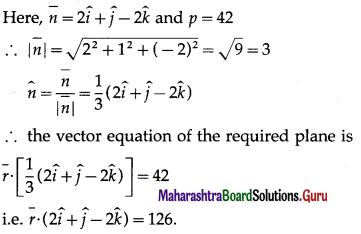
Find the vector equation of a plane which is at 42 unit distance from the origin and which is normal to the vector \(2 \hat{i}+\hat{j}-2 \hat{k}\).
Solution:
If \(\hat{n}\) is a unit vector along the normal and p is the length of the perpendicular from origin to the plane, then the vector equation of the plane is \(\bar{r} \cdot \hat{n}\) = p
Question 2.
Find the perpendicular distance of the origin from the plane 6x – 2y + 3z – 7 = 0.
Solution:
The equation of the plane is
6x – 2y + 3z – 7 = 0
∴ its vector equation is
\(\bar{r} \cdot(6 \hat{i}-2 \hat{j}+3 \hat{k})\) = 7 ….(1)
where \(\bar{r}=x \hat{i}+y \hat{j}+z \hat{k}\)
∴ \(\bar{n}=6 \hat{i}-2 \hat{j}+3 \hat{k}\) is normal to the plane
\(|\bar{n}|=\sqrt{6^{2}+(-2)^{2}+3^{2}}=\sqrt{49}\) = 7
Unit vector along \(\bar{n}\) is
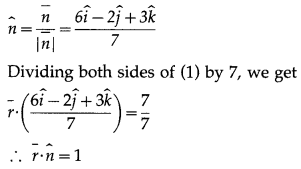
Comparing with normal form of equation of the plane \(\bar{r} \cdot \hat{n}\) = p, it follows that length of perpendicular from origin is 1 unit.
Alternative Method:
The equation of the plane is 6x – 2y + 3z – 7 = 0 i.e. 6x – 2y + 3z = 7
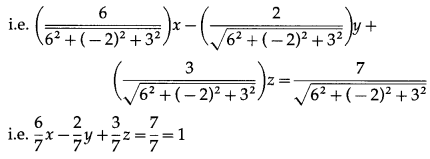
This is the normal form of the equation of plane.
∴ perpendicular distance of the origin from the plane is p = 1 unit.

Question 3.
Find the coordinates of the foot of the perpendicular drawn from the origin to the plane 2x + 6y – 3z = 63 .
Solution:
The equation of the plane is 2x + 6y – 3z = 63. Dividing each term by \(\sqrt{2^{2}+6^{2}+(-3)^{2}}=\sqrt{49}\) = 7, we get
\(\frac{2}{7} x+\frac{6}{7} y-\frac{3}{7} z=\frac{63}{7}\) = 9
This is the normal form of the equation of plane.
∴ the direction cosines of the perpendicular drawn from the origin to the plane are
l = \(\frac{2}{7}\), m = \(\frac{6}{7}\), n = \(-\frac{3}{7}\)
and length of perpendicular from origin to the plane is p = 9.
∴ the coordinates of the foot of the perpendicular from the origin to the plane are (lp, mp, np) i.e. \(\left(\frac{18}{7}, \frac{54}{7},-\frac{27}{7}\right)\).
Question 4.
Reduce the equation \(\bar{r} \cdot(3 \hat{i}+4 \hat{j}+12 \hat{k})\) = 78 to normal form and hence find
(i) the length of the perpendicular from the origin to the plane
(ii) direction cosines of the normal.
Solution:
The normal form of equation of a plane is \(\bar{r} \cdot \hat{n}\) = p where \(\hat{n}\) is unit vector along the normal and p is the length of perpendicular drawn from origin to the plane.
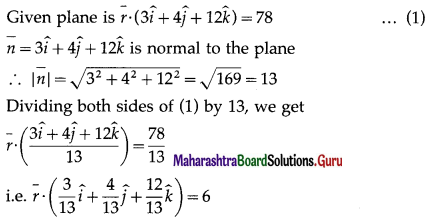
This is the normal form of the equation of plane. Comparing with \(\bar{r} \cdot \hat{n}\) = p,
(i) the length of the perpendicular from the origin to plane is 6.
(ii) direction cosines of the normal are \(\frac{3}{13}, \frac{4}{13}, \frac{12}{13}\).
Question 5.
Find the vector equation of the plane passing through the point having position vector \(\hat{i}+\hat{j}+\hat{k}\) and perpendicular to the vector \(4 \hat{i}+5 \hat{j}+6 \hat{k}\).
Solution:
The vector equation of the plane passing through the point A (\(\bar{a}\)) and perpendicular to the vector \(\bar{n}\) is \(\bar{r} \cdot \bar{n}=\bar{a} \cdot \bar{n}\)
Here, \(\bar{a}=\hat{i}+\hat{j}+\hat{k}\), \(\bar{n}=4 \hat{i}+5 \hat{j}+6 \hat{k}\)
∴ \(\bar{a} \cdot \bar{n}\) = \((\hat{i}+\hat{j}+\hat{k}) \cdot(4 \hat{i}+5 \hat{j}+6 \hat{k})\)
= (1)(4) + (1)(5) + (1)(6)
= 4 + 5 + 6 = 15
∴ the vector equation of the required plane is \(\bar{r} \cdot(4 \hat{i}+5 \hat{j}+6 \hat{k})\) = 15.
Question 6.
Find the Cartesian equation of the plane passing through A( -1, 2, 3), the direction ratios of whose normal are 0, 2, 5.
Solution:
The cartesian equation of the plane passing ; through (x
1
, y
1
, z
1
), the direction ratios of whose normal are a, b, c, is
a(x – x
1
) + b(y – y
1
) + c(z – z
1
) = 0
∴ the cartesian equation of the required plane is
0(x +1) + 2(y – 2) + 5(z – 3) = 0
i.e. 0 + 2y – 4 + 5z – 15 = 0
i.e. 2y + 5z = 19.
Question 7.
Find the Cartesian equation of the plane passing through A(7, 8, 6) and parallel to the XY plane.
Solution:
The cartesian equation of the plane passing through (x
1
, y
1
, z
1
), the direction ratios of whose normal are a, b, c, is
a(x – x
1
) + b(y – y
1
) + c(z – z
1
) = 0
The required plane is parallel to XY-plane.
∴ it is perpendicular to Z-axis i.e. Z-axis is normal to the plane. Z-axis has direction ratios 0, 0, 1.
The plane passes through (7, 8, 6).
∴ the cartesian equation of the required plane is
0(x – 7) + 0(y – 8) + 1 (z – 6) = 0
i.e. z = 6.
Question 8.
The foot of the perpendicular drawn from the origin to a plane is M(1, 0, 0). Find the vector equation of the plane.
Solution:
The vector equation of the plane passing ; through A(\(\bar{a}\)) and perpendicular to \(\bar{n}\) is \(\bar{r} \cdot \bar{n}=\bar{a} \cdot \bar{n}\).
M(1, 0, 0) is the foot of the perpendicular drawn from ; origin to the plane. Then the plane is passing through M : and is perpendicular to OM.
If \(\bar{m}\) is the position vector of M, then \(\bar{m}\) = \(\hat{i}\)
Normal to the plane is
\(\bar{n}\) = \(\overline{\mathrm{OM}}\) = \(\hat{i}\)
\(\bar{m} \cdot \bar{n}=\hat{i} \cdot \hat{i}\) = 1
∴ the vector equation of the required plane is \(\bar{r} \cdot \hat{i}\) = 1
Question 9.
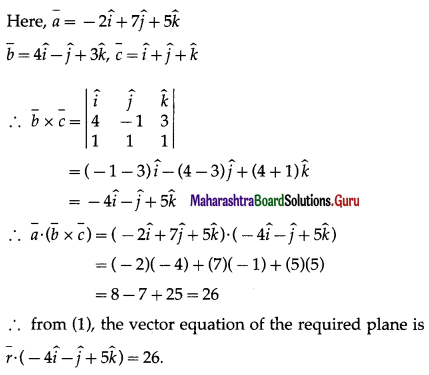
Find the vector equation of the plane passing through the point A(-2, 7, 5) and parallel to vectors \(\hat{4}-\hat{j}+3 \hat{k}\) and \(\hat{i}+\hat{j}+\hat{k}\).
Solution:
The vector equation of the plane passing through the point A(\(\bar{a}\)) and parallel to the vectors \(\bar{b}\) and \(\bar{c}\) is
\(\bar{r} \cdot(\bar{b} \times \bar{c})=\bar{a} \cdot(\bar{b} \times \bar{c})\) ….(1)
Question 10.
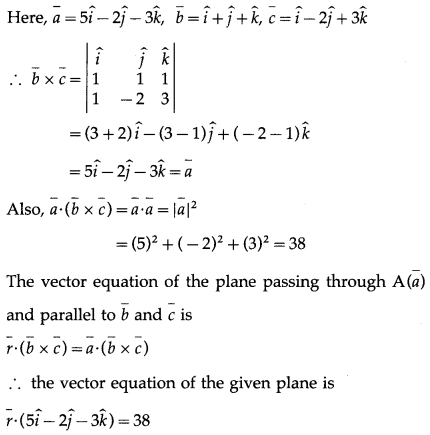
Find the Cartesian equation of the plane \(\bar{r}=(5 \hat{i}-2 \hat{j}-3 \hat{k})+\lambda(\hat{i}+\hat{j}+\hat{k})+\mu(\hat{i}-2 \hat{j}+3 \hat{k})\)
Solution:
The equation \(\) represents a plane passing through a point having position vector \(\bar{a}\) and parallel to vectors \(\bar{b}\) and \(\bar{c}\).

∴ 5x – 2y – 3z = 38.
This is the cartesian equation of the required plane.
Question 11.
Find the vector equation of the plane which makes intercepts 1, 1, 1 on the co-ordinates axes.
Solution:
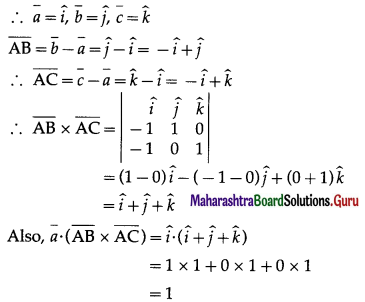
The vector equation of the plane passing through A(\(\bar{a}\)), B(\(\bar{b}\)). C(\(\bar{c}\)), where A, B, C are non-collinear is \(\bar{r} \cdot(\overline{\mathrm{AB}} \times \overline{\mathrm{AC}})\) = \(\bar{a} \cdot(\overline{\mathrm{AB}} \times \overline{\mathrm{AC}})\) … (1)
The required plane makes intercepts 1, 1, 1 on the coordinate axes.
∴ it passes through the three non-collinear points A (1, 0, 0), B = (0, 1, 0), C = (0, 0, 1)
∴ from (1), the vector equation of the required plane is \(\bar{r} \cdot(\hat{i}+\hat{j}+\hat{k})\) = 1.