
Balbharti 12th Maharashtra State Board Maths Solutions Book Pdf Chapter 6 Differential Equations Ex 6.3 Questions and Answers.
12th Maths Part 2 Differential Equations Exercise 6.3 Questions And Answers Maharashtra Board
Question 1.
In each of the following examples verify that the given expression is a solution of the corresponding differential equation.
(i) xy = log y + c; \(\frac{d y}{d x}=\frac{y^{2}}{1-x y}\)
Solution:
xy = log y + c
Differentiating w.r.t. x, we get
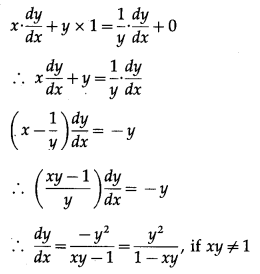
Hence, xy = log y + c is a solution of the D.E.
\(\frac{d y}{d x}=\frac{y^{2}}{1-x y^{\prime}}, x y \neq 1\)
(ii) y = (sin
-1
x)
2
+ c; (1 – x
2
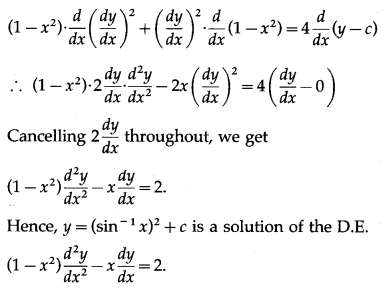
) \(\frac{d^{2} y}{d x^{2}}-x \frac{d y}{d x}=2\)
Solution:
y = (sin
-1
x)
2
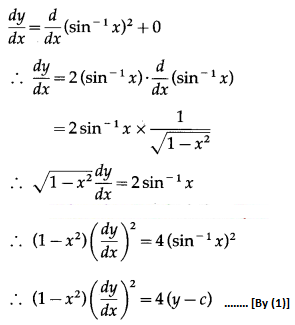
+ c …….(1)
Differentiating w.r.t. x, we get
Differentiating again w.r.t. x, we get

(iii) y = e
-x
+ Ax + B; \(e^{x} \frac{d^{2} y}{d x^{2}}=1\)
Solution:
y = e
-x
+ Ax + B
Differentiating w.r.t. x, we get
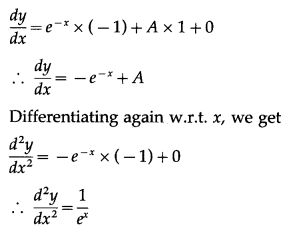
∴ \(e^{x} \frac{d^{2} y}{d x^{2}}=1\)
Hence, y = e
-x
+ Ax + B is a solution of the D.E.
\(e^{x} \frac{d^{2} y}{d x^{2}}=1\)
(iv) y = x
m
; \(x^{2} \frac{d^{2} y}{d x^{2}}-m x \frac{d y}{d x}+m y=0\)
Solution:
y = x
m
Differentiating twice w.r.t. x, we get
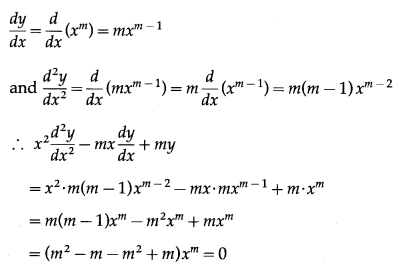
This shows that y = x
m
is a solution of the D.E.
\(x^{2} \frac{d^{2} y}{d x^{2}}-m x \frac{d y}{d x}+m y=0\)
(v) y = a + \(\frac{b}{x}\); \(x \frac{d^{2} y}{d x^{2}}+2 \frac{d y}{d x}=0\)
Solution:
y = a + \(\frac{b}{x}\)
Differentiating w.r.t. x, we get
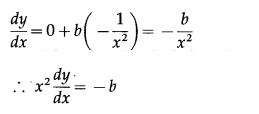
Differentiating again w.r.t. x, we get
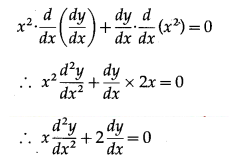
Hence, y = a + \(\frac{b}{x}\) is a solution of the D.E.
\(x \frac{d^{2} y}{d x^{2}}+2 \frac{d y}{d x}=0\)
(vi) y = e
ax
; x \(\frac{d y}{d x}\) = y log y
Solution:
y = e
ax
log y = log e
ax
= ax log e
log y = ax …….(1) ……..[∵ log e = 1]
Differentiating w.r.t. x, we get
\(\frac{1}{y} \cdot \frac{d y}{d x}\) = a × 1
∴ \(\frac{d y}{d x}\) = ay
∴ x \(\frac{d y}{d x}\) = (ax)y
∴ x \(\frac{d y}{d x}\) = y log y ………[By (1)]
Hence, y = e
ax
is a solution of the D.E.
x \(\frac{d y}{d x}\) = y log y.
Question 2.
Solve the following differential equations.
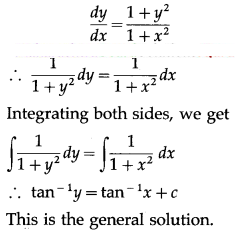
(i) \(\frac{d y}{d x}=\frac{1+y^{2}}{1+x^{2}}\)
Solution:
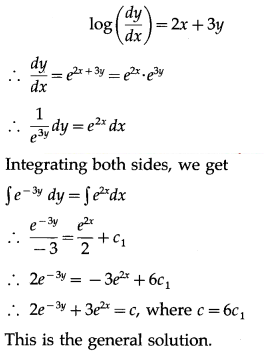
(ii) log(\(\frac{d y}{d x}\)) = 2x + 3y
Solution:
(iii) y – x \(\frac{d y}{d x}\) = 0
Solution:
y – x \(\frac{d y}{d x}\) = 0
∴ x \(\frac{d y}{d x}\) = y
∴ \(\frac{1}{x} d x=\frac{1}{y} d y\)
Integrating both sides, we get
\(\int \frac{1}{x} d x=\int \frac{1}{y} d y\)
∴ log |x| = log |y| + log c
∴ log |x| = log |cy|
∴ x = cy
This is the general solution.
(iv) sec
2
x . tan y dx + sec
2
y . tan x dy = 0
Solution:
sec
2
x . tan y dx + sec
2
y . tan x dy = 0
∴ \(\frac{\sec ^{2} x}{\tan x} d x+\frac{\sec ^{2} y}{\tan y} d y=0\)
Integrating both sides, we get
\(\int \frac{\sec ^{2} x}{\tan x} d x+\int \frac{\sec ^{2} y}{\tan y} d y=c_{1}\)
Each of these integrals is of the type
\(\int \frac{f^{\prime}(x)}{f(x)} d x\) = log |f(x)| + c
∴ the general solution is
∴ log|tan x| + log|tan y | = log c, where c
1
= log c
∴ log |tan x . tan y| = log c
∴ tan x . tan y = c
This is the general solution.
(v) cos x . cos y dy – sin x . sin y dx = 0
Solution:
cos x . cos y dy – sin x . sin y dx = 0
\(\frac{\cos y}{\sin y} d y-\frac{\sin x}{\cos x} d x=0\)
Integrating both sides, we get
∫cot y dy – ∫tan x dx = c
1
∴ log|sin y| – [-log|cos x|] = log c, where c
1
= log c
∴ log |sin y| + log|cos x| = log c
∴ log|sin y . cos x| = log c
∴ sin y . cos x = c
This is the general solution.
(vi) \(\frac{d y}{d x}\) = -k, where k is a constant.
Solution:
\(\frac{d y}{d x}\) = -k
∴ dy = -k dx
Integrating both sides, we get
∫dy = -k∫dx
∴ y = -kx + c
This is the general solution.
(vii) \(\frac{\cos ^{2} y}{x} d y+\frac{\cos ^{2} x}{y} d x=0\)
Solution:
\(\frac{\cos ^{2} y}{x} d y+\frac{\cos ^{2} x}{y} d x=0\)
∴ y cos
2
y dy + x cos
2
x dx = 0
∴ \(x\left(\frac{1+\cos 2 x}{2}\right) d x+y\left(1+\frac{\cos 2 y}{2}\right) d y=0\)
∴ x(1 + cos 2x) dx + y(1 + cos 2y) dy = 0
∴ x dx + x cos 2x dx + y dy+ y cos 2y dy = 0
Integrating both sides, we get
∫x dx + ∫y dy + ∫x cos 2x dx + ∫y cos 2y dy = c
1
……..(1)
Using integration by parts
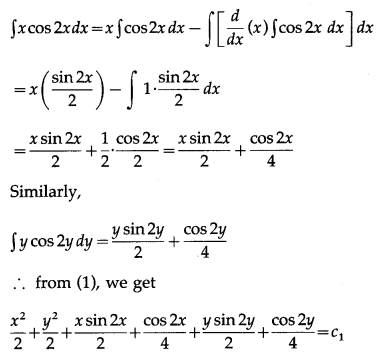
Multiplying throughout by 4, this becomes
2x
2
+ 2y
2
+ 2x sin 2x + cos 2x + 2y sin 2y + cos 2y = 4c
1
∴ 2(x
2
+ y
2
) + 2(x sin 2x + y sin 2y) + cos 2y + cos 2x + c = 0, where c = -4c
1
This is the general solution.
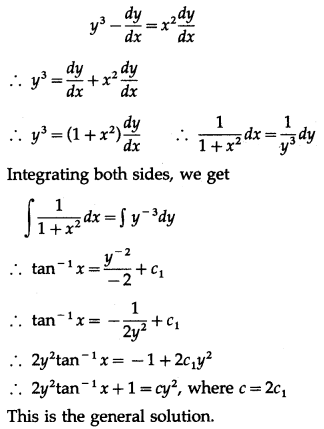
(viii) \(y^{3}-\frac{d y}{d x}=x^{2} \frac{d y}{d x}\)
Solution:
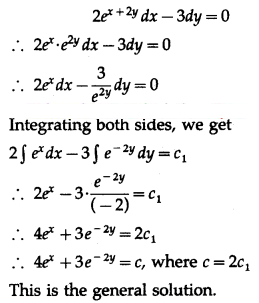
(ix) 2e
x+2y
dx – 3 dy = 0
Solution:
(x) \(\frac{d y}{d x}\) = e
x+y
+ x
2
e
y
Solution:
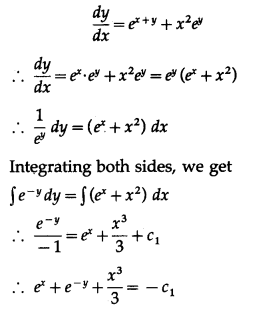
∴ 3e
x
+ 3e
-y
+ x
3
= -3c
1
∴ 3e
x
+ 3e
-y
+ x
3
= c, where c = -3c
1
This is the general solution.
Question 3.
For each of the following differential equations, find the particular solution satisfying the given condition:
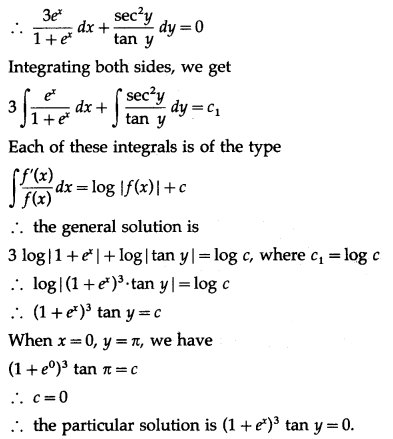
(i) 3e
x
tan y dx + (1 + e
x
) sec
2
y dy = 0, when x = 0, y = π
Solution:
3e
x
tan y dx + (1 + e
x
) sec
2
y dy = 0
(ii) (x – y
2
x) dx – (y + x
2
y) dy = 0, when x = 2, y = 0
Solution:
(x – y
2
x) dx – (y + x
2
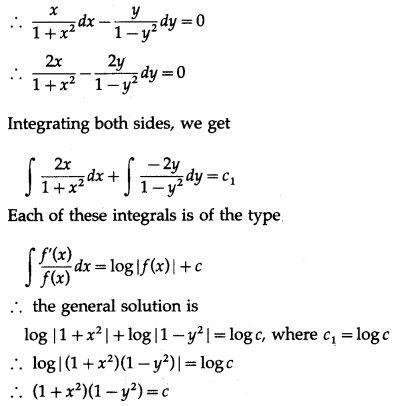
y) dy = 0
∴ x(1 – y
2
) dx – y(1 + x
2
) dy = 0
When x = 2, y = 0, we have
(1 + 4)(1 – 0) = c
∴ c = 5
∴ the particular solution is (1 + x
2
)(1 – y
2
) = 5.
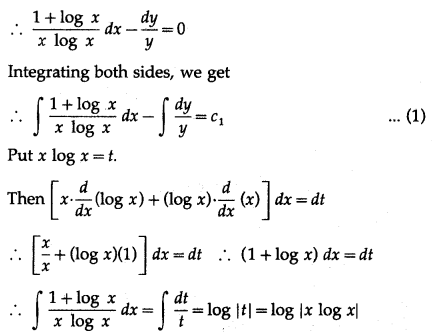
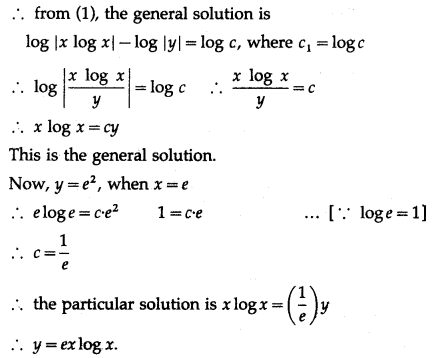
(iii) y(1 + log x) \(\frac{d x}{d y}\) – x log x = 0, y = e
2
, when x = e
Solution:
y(1 + log x) \(\frac{d x}{d y}\) – x log x = 0
(iv) (e
y
+ 1) cos x + e
y
sin x \(\frac{d y}{d x}\) = 0, when x = \(\frac{\pi}{6}\), y = 0
Solution:
(e
y
+ 1) cos x + e
y
sin x \(\frac{d y}{d x}\) = 0
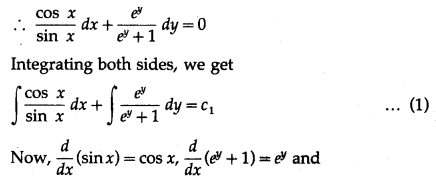
\(\int \frac{f^{\prime}(x)}{f(x)} d x\) = log|f(x)| + c
∴ from (1), the general solution is
log|sin x| + log|e
y
+ 1| = log c, where c
1
= log c
∴ log|sin x . (e
y
+ 1)| = log c
∴ sin x . (e
y
+ 1) = c
When x = \(\frac{\pi}{4}\), y = 0, we get
\(\left(\sin \frac{\pi}{4}\right)\left(e^{0}+1\right)=c\)
∴ c = \(\frac{1}{\sqrt{2}}\)(1 + 1) = √2
∴ the particular solution is sin x . (e
y
+ 1) = √2
(v) (x + 1) \(\frac{d y}{d x}\) – 1 = 2e
-y
, y = 0, when x = 1
Solution:
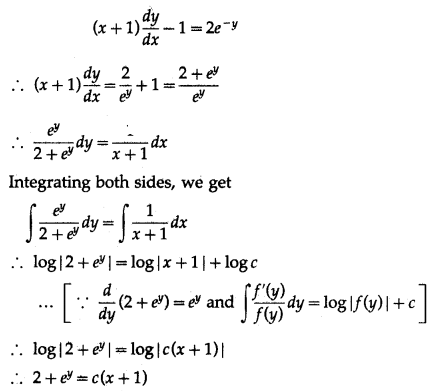
This is the general solution.
Now, y = 0, when x = 1
∴ 2 + e
0
= c(1 + 1)
∴ 3 = 2c
∴ c = \(\frac{3}{2}\)
∴ the particular solution is 2 + e
y
= \(\frac{3}{2}\) (x + 1)
∴ 2(2 + e
y
) = 3(x + 1).
(vi) cos(\(\frac{d y}{d x}\)) = a, a ∈ R, y (0) = 2
Solution:
cos(\(\frac{d y}{d x}\)) = a
∴ \(\frac{d y}{d x}\) = cos
-1
a
∴ dy = (cos
-1
a) dx
Integrating both sides, we get
∫dy = (cos
-1
a) ∫dx
∴ y = (cos
-1
a) x + c
∴ y = x cos
-1
a + c
This is the general solution.
Now, y(0) = 2, i.e. y = 2,
when x = 0, 2 = 0 + c
∴ c = 2
∴ the particular solution is
∴ y = x cos
-1
a + 2
∴ y – 2 = x cos
-1
a
∴ \(\frac{y-2}{x}\) = cos
-1
a
∴ cos(\(\frac{y-2}{x}\)) = a
Question 4.
Reduce each of the following differential equations to the variable separable form and hence solve:
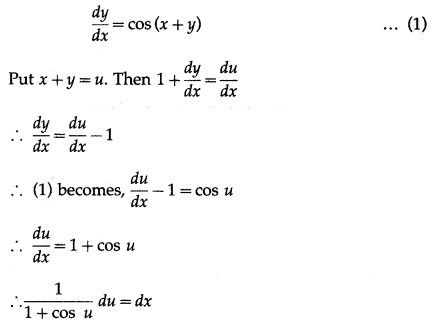
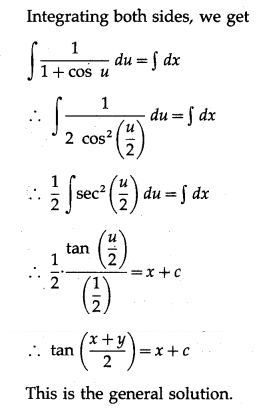
(i) \(\frac{d y}{d x}\) = cos(x + y)
Solution:
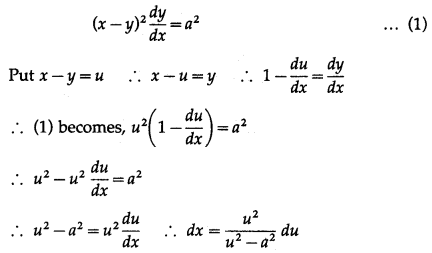
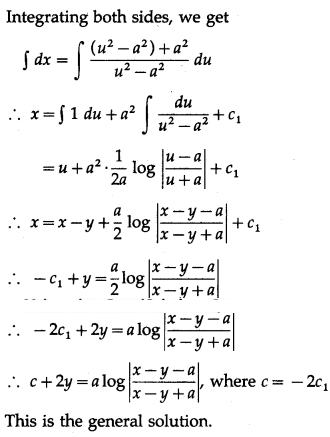
(ii) (x – y)
2
\(\frac{d y}{d x}\) = a
2
Solution:
(iii) x + y \(\frac{d y}{d x}\) = sec(x
2
+ y
2
)
Solution:
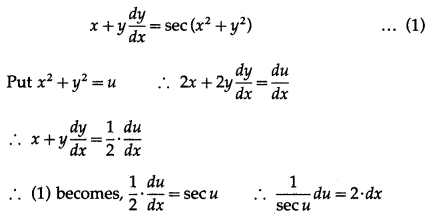
Integrating both sides, we get
∫cos u du = 2 ∫dx
∴ sin u = 2x + c
∴ sin(x
2
+ y
2
) = 2x + c
This is the general solution.
(iv) cos
2
(x – 2y) = 1 – 2 \(\frac{d y}{d x}\)
Solution:
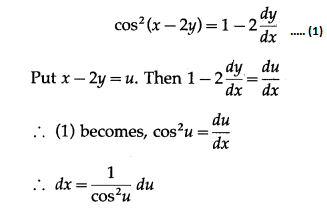
Integrating both sides, we get
∫dx = ∫sec
2
u du
∴ x = tan u + c
∴ x = tan(x – 2y) + c
This is the general solution.
(v) (2x – 2y + 3) dx – (x – y + 1) dy = 0, when x = 0, y = 1
Solution:
(2x – 2y + 3) dx – (x – y + 1) dy = 0
∴ (x – y + 1) dy = (2x – 2y + 3) dx
∴ \(\frac{d y}{d x}=\frac{2(x-y)+3}{(x-y)+1}\) ………(1)
Put x – y = u, Then \(1-\frac{d y}{d x}=\frac{d u}{d x}\)
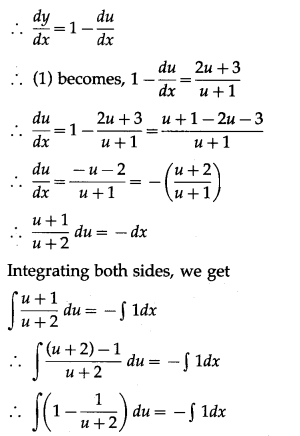
∴ u – log|u + 2| = -x + c
∴ x – y – log|x – y + 2| = -x + c
∴ (2x – y) – log|x – y + 2| = c
This is the general solution.
Now, y = 1, when x = 0.
∴ (0 – 1) – log|0 – 1 + 2| = c
∴ -1 – o = c
∴ c = -1
∴ the particular solution is
(2x – y) – log|x – y + 2| = -1
∴ (2x – y) – log|x – y + 2| + 1 = 0