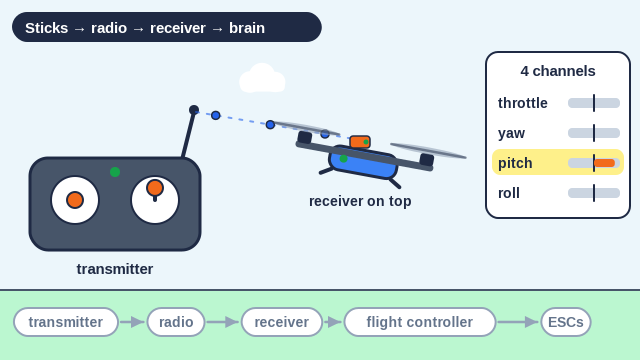
The pilot holds the transmitter with two sticks and some switches. It sends commands by radio to the receiver on the drone — but only after the two are linked, which is called binding. Each stick direction travels on its own channel (throttle, yaw, pitch, roll), and switches add more, like the arm switch that lets the motors spin. The flight controller mixes the commands with its sensors and tells the ESCs what to do. A failsafe decides what happens if the signal is lost: land or come home.
✓ You passed this lesson’s test.
🎬 See it move
The pilot holds the transmitter: two sticks and some switches.
Read what the teacher says
The pilot holds the transmitter: two sticks and some switches.
First the receiver is linked to this one transmitter. That is called binding.
Each stick direction has its own channel: throttle, yaw, pitch and roll — 4 channels.
The path: transmitter → radio → receiver → flight controller → ESCs.
Signal lost? The failsafe takes over and the drone lands — or comes home.
Bind, channel, failsafe. Disarm right after landing.
Work it out in your head or on paper, then tap your answer — or type it and press Check. Stuck? Press “Show me how”.
Right: 0 · Tried: 0
🏁 Lesson 19 test
20 questions. Check each answer, then go to the next one. Get 16 or more right to pass.
🏅 Sign in with Google to earn the
📡 Radio Link Expert badge when you pass — and a certificate when you finish all 8 lessons of
Part 3 · Build a drone. You can still take the test without signing in.
👩🏫 Drones classes — live online, request a call back
Prefer a real teacher? TalentJR teachers take live online classes anywhere in India. Tell us what
you need and our team will call you with timings and fees.
💻Live online classesSmall groups or 1:1 with a teacher, from home, any city.
📞We call you backOur team asks what your child needs, then shares timings and fees.
🏠Home tutor?We are still building our list of home tutors — ask on the call if there is one near you.